


Our new home at Tarrant Gallery, Tarrant Street, Arundel - the cultural hub of Arundel.

In the cultural heart of Arundel the Tarrant Gallery is on the bustling Tarrant Street, home to three more contemporary galleries, a contemporary jeweller, a milliner and the Victoria Institute Arts Centre.
Since the mid 19th century, when train travel became popular with the masses, Arundel has been a haven for visitors and local residents alike.
The reason is clear to see, Arundel, described as the 'Jewel in the Crown of West Sussex' has a rich historic heritage. Today Arundel retains that heritage and has a new reputation for contemporary arts (music, theatre and visual arts) based on the many artists who moved here in the 1950's, some of whom helped establish the annual Arundel Festival of the Arts and Arundel Gallery Trail in August each year.
A Potted History of Tarrant Street
The name Tarrant is derived from the ancient Celtic Trisanton meaning ‘the great wanderer’ or ‘strong flooder’. Both are good descriptions of the River Arun today, which winds its way up the Arun Valley to Pulborough and beyond and which overflows into the flood plains at Arundel, Amberley and Pulborough Brooks.
Long before it was called River Arun, the local river was recorded in Anglo Saxon charters as Tarente or Tarrant in AD725. In later centuries the river was know as Arundel River, before the 16th century back formation to River Arun.

Tarrant St is one of the oldest and most vibrant commercial roads in the Old Town. It now serves as a living archive of the town’s shifting economy - from brewing & newspaper printing to independent retail, coffee shops, pubs & restaurants.
For a listing of Arundel traders circa 1840 see Pigot & Co Directory (Transcribed by Mark Collins. Click here to see the original Pigot and Co Directory pages.
Remains of a Roman villa have been found at the west end of Tarrant Street from c.1896 onwards. Discoveries include a Roman pavement and tiles, traces of a heated room (in front of 60 Tarrant Street) and a well and floor (at 95 Tarrant Street). In 1983 the south end of the villa was located on the south side of Tarrant Street. At the rear of the Coach House, 54-6 Tarrant Street, further evidence of the villa was found in 1995 in the form of a probable Roman chalk and flint wall footing 2.12m long and 400mm wide exposed during creation of a drain.
The old port in Arundel was a busy inland trading hub along the River Arun, featuring key locations like Town Quay, the Nineveh Ship Yard, and historical wharves.
Nineveh Shipyard was the vital economic hub of the Town as the Port of Arundel. It handled major shipments of coal, timber, and grain before declining in the late 19th century due to the railways. Goods would arrive by large ship and then be transferred to smaller canal boats for onward travel to London and other markets on the Wey and Arun cnal.
Arundel was a registered as a port by 1071, using the River Arun to connect coastal shipping to inland markets. Town Quay also known as Mayor's Quay, handled vessels up to 300 tons carrying coal, salt, chalk, and timber.

Nineveh Ship Yard built ships up to 300 tons alongside smaller river craft, including the Michelgrove in Tudor times, a model of which can be seen today in Arundel Museum.
Michelgrove and the Norfolks
Michelgrove near Clapham, was the home of the Michelgrove family, inherited by John Shelley through marriage in 1474.
The Dukes of Norfolk and the Shelleys of Michelgrove shared a powerful, centuries-long history/feud in West Sussex political rivalry.

The Shelley family owned the grand Michelgrove estate near Clapham and Patching from the late 15th century, sitting right next to the vast Sussex domains of the Howards (Dukes of Norfolk).
The two families frequently competed for social dominance and political influence, including notoriously rough and corrupt Georgian parliamentary and local elections in nearby Arundel. Burdened by financial troubles, the 6th Baronet Shelley sold the ancient Michelgrove property in 1800 to a Liverpool merchant named Richard Walker.
In 1827 and 1828, the financially ruined Walker family sold the mansion and parkland to Bernard Edward Howard, the 12th Duke of Norfolk. Because the Duke already had primary ducal seats like Arundel Castle, he had no need for the massive Michelgrove House. He demolished the historic mansion around 1828–1832 to merge the parklands and surrounding acreage directly into the Norfolk estate. Only a few fragment walls and a ruined turret from the old Shelley estate survive on the grounds today, hidden away in the West Sussex countryside.
The Decline of Arundel as a Bonded Port
The town served as a bonding port in 1817 with its own Custom House on Maltravers Street before administrative control shifted to Littlehampton in 1850. The customs post operated from Maltravers Street in Arundel during the town's active trading port era, managing river traffic, cargo duties, and auctions for seized smuggled goods.
Sadly, with the expansion of the railway brought about the decline of Arundel as a major port. The construction of fixed and swinging railway bridges (such as at Ford and Littlehampton) restricted large vessel navigation so, larger, deeper-draft sailing ships could no longer go up the winding River Arun, moving commercial traffic downriver.
Commercial river traffic was virtually extinct by 1910, with the final large sailing vessel visiting in 1917
In 1910 Tarrant Street boasted multiple general stores, and shops stretched all the way to its western end. Over the decades, retail concentrated closer to High Street, converting the western end back into residential buildings.
Nineveh Shipyard is now a development of town houses designed by renowned local architect, Neil Holland.
Town Quay is now a place for public seating and cafe's to spill out onto the large paved area on the banks of the river Arun. Greening Arundel have filled the flower beds with a range of wiild flowers and herbs.
Buildings and Galleries along Tarrant Street

Before moving to its iconic Tudor-style brick building on High Street in 1895, the local Arundel Post Office spent part of the 19th century operating directly out of Tarrant Street.
The Kings Arms further west down Tarrant Street is believed to be the oldest pub in Arundel, dating back to 1625.

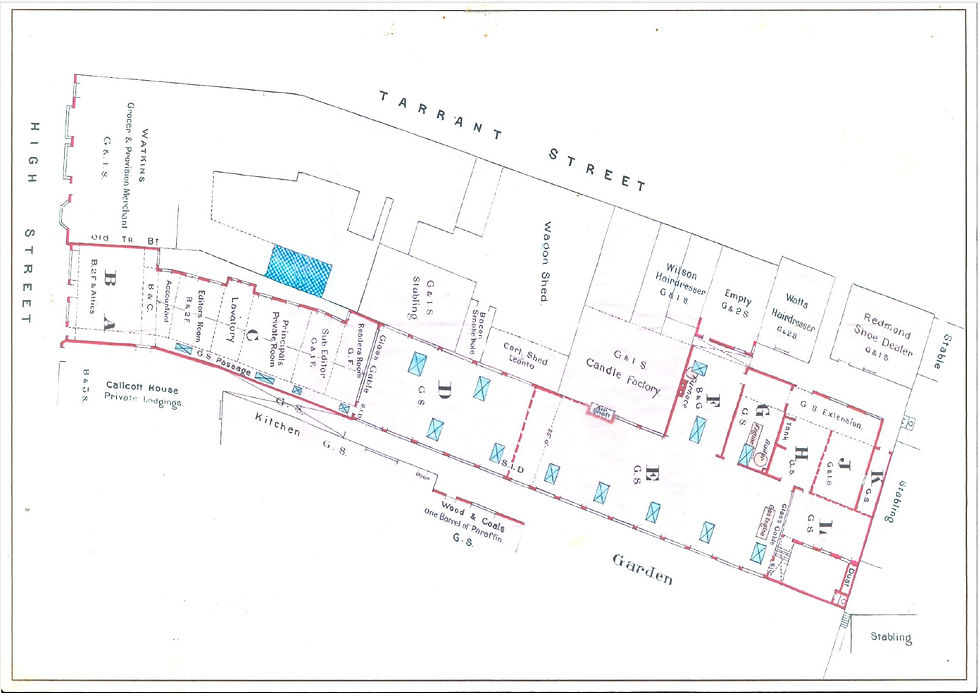
Next to Tarrant Gallery is The Old Print Works Arcade. Originally the 1800s printing house for the West Sussex Gazette, this Victorian building, designed by Wheeler and Lodge of London, was once described as the “most artistic county newspaper office in England”.
Printing operations stopped in 1969 (having moved to Portsmouth) and the buildings were converted to retail space and an arcade in the early 1980's. Today, it is home to an independent shops, with a barber shop.

The Victoria Institute known as “The Vic,” is a Grade II listed building, erected in 1897 to mark Queen Victoria’s Diamond Jubilee. It replaced the failed 1847 Arundel Savings Bank and originally featured reading rooms and a communal laundry to benefit working-class locals. Now it is a community art centre hosting a programme of music, drama and visual art events.

Grade II Listed Nineveh House is a beautiful neo-Norman/Romanesque Revival building built in 1784 by a group of independent Christians. The building we know today replaced a large mansion, also called Nineveh House, built circa 1420 by 13th Earl Arundel, John Fitzalan. The grounds went down to the river Arun, adjacent to the Port. Only a few remants of this building remain as gate posts.
This non-conformist chapel hosted regular services for two centuries until the 1980s. It now serves as a vibrant indoor market for independent shops, art, and antiques. Located on Tarrant Street, two floors of local artisans, craft experts, and collectors.

Our new home, Tarrant Gallery was built in 1780 on old stabling land.


If you've been looking for a place where entries are actually maintained by the people who care about them, this kind of setup tends to work better than static pages. Worth checking out when you get a moment if that style appeals to you.