


Christopher Marvell Sculpture and How to Place Larger works in a Garden Setting
Placing art outside, whether in a private garden or public park, town square or even a roundabout influences the way we perceive and engage with our surroundings fostering a sense of place.
Firstly, it shows that the space is cared about and secondly the owners want people to pause and enjoy the moment. Finally, as with all art, the viewers or audience are encouraged to think about the subject of the work, the environment that it is in and how the two interact.
In a public setting art boosts community identity and cohesion, improves mental well being and drives local economic growth. It can turn otherwise dull environments into vibrant areas, sparks important social conversations and give people a free, accessible way to experience culture outside of traditional museums.
These effects to a greater or lesser extent also occur when sculpture is placed in a private setting. After all, isn't this why we buy art for our home in the first place?
Sculpture by Christopher Marvell
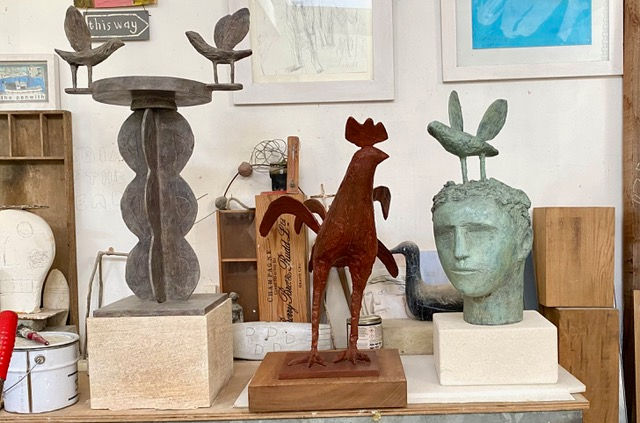
Christopher Marvell is known for his humorous, quirky sculptures of animals, birds and people.
He says "None of my sculptures are particularly anybody or anything, it's just a head, just an owl, just a dog. They're emblematic: shapes, forms, emotions.."
Christopher Marvell continues "Walking daily through the landscapes around the studios gives a constant focus for what I am trying to make. My sculptures have a quiet english based quality of man and nature in the way that we hear countryside through Britton or Vaughan Williams.".
Jeremy Musson, architectural historian, writer, consultant, and lecturer, said of Marvell's sculpture "Conceived through drawing, expressed initially in maquette, fixed in plaster and fully realised in bronze, the sculpture of Christopher Marvell is sparing in detail but fulsome in association. The solid, substantial, patinated human and animal subjects that constitute the larger part of his output manage to achieve an irresistible balance between humour and pathos, ugliness and beauty, strength and weakness, past and present, and art and craft. Bringing to mind elements of the works of Marini, Giacometti, Miro and Moore, Christopher Marvell’s broadly representational sculpture is often charmingly quirky without ever being diminished by its idiosyncrasy."
Here are some examples of recent larger sculptures by Christopher Marvell.
Boy and Bird Bronze by Christopher Marvell St Francis Bronze by Christopher Marvell Woman and Peacock Bronze by Christopher Marvell Green Birdman Head Bronze by Christopher Marvell Tall Wading Bird Bronze by Christopher Marvell Red Cockerel Bronze by Christopher Marvell
Top:
Boy and Bird - 115 x 30 x 30 cm
St Francis - 107 x 75 x 28 cm
Middle:
Woman and Peacock - 67 x 25 x 20 cm
Green Birdman Head - 62 x 25 x 31cm
Bottom:
Tall Wading Bird - 129 x 78 x 48 cm
Red Cockerel - 64 x 68 x 41 cm
In addition to his figurative sculptures Christopher Marvell creates ingenious original birdbaths.
See below: Scallop Birdbath - 77 x 30 x 51 cm
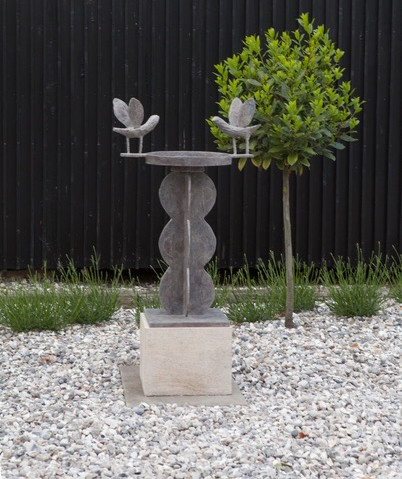
All of the pieces shown here are in cast bronze in edtions of 5 or less.
How to Place a Sculpture outside
The best way to place a sculpture in a garden is to use it as a visual anchor or focal point to draw the eye.
Position it at the end of a path, tucked into a border for surprise, or aligned with a window view from your house.
Choose a piece that is in harmony with its surroundings, a piece that resonates with the style of the garden design. For example a modern minimalist garden might suit a conceptual or abstract work in steel or polished stone; however, a Classic english garden would suit a more reflective, figurative or romantic piece in patinated bronze; finally for wild flower gardens natural organic wood carvings or stone monoliths work well.
In any case large sculpture should make a impression: This could be in terms of drama or as an artistic statement, most municipal or tradtional sculptures are commemorative and this could also be the case in a private setting. We have had many clients wanting to remember a person or event through placing a sculpture in their garden.
It is important to balance the scale of the piece with your space, too small and it will get lost, too large and it might dominate rather than complement the garden.
Placement and Sight Lines:
End of paths: Place a piece where a walkway ends to give the eye a clear destination.
Framed views: Position the artwork where hedges, trees, or arches frame it naturally.
Indoor connections: Look out from your kitchen or living room windows to position art where it catches your eye from inside.
Hidden discovery: Tuck wildlife or playful pieces deep into plant beds so visitors find them by accident.
Style and Contrast:
Create contrast: Pair sharp, modern metal or geometric shapes against soft, flowing flowers and green foliage.
Blend naturally: Let stone or concrete weather with moss over time so classical pieces look established.
Scale correctly: Use one bold statement piece in small courtyards rather than cluttering the space with many small items.
Practical Installation - points to note:
Solid base: Rest heavy statues on a hidden paving slab beneath the lawn or soil to stop them from sinking or tilting. If your piece is on a wooden base (e.g. oak) then raise it up on a matal base to stop the wood from rotting.
Plant growth: Account for how tall surrounding perennials grow so the art does not vanish behind summer foliage.
Wind safety: Anchor tall or top-heavy installations securely to prevent tipping during winter storms.
Contact us to discuss sourcing a sculpture for your house or garden.


Comments