


CURRENT EXHIBITIONS
Here we will list our forthcoming contemporary art exhibitions, pop-ups and events.
click here us to view past exhibitions.
In the future we will present virtual exhibitions, with pop-ups at venues in Sussex and London.
You can request to see available works even if the piece or artist is not currently being exhibited.
Please take a look at the Artists we show or take a look around our Editions Shop.
Contact us with any questions or artist/artwork questions.

Caron Penny and Katharine Swailes
Weftfaced for Sussex Craft Week 2026
An exhibition of recent handwoven tapestry by Caron Penney and Katharine Swailes, two leading practitioners in contemporary woven practice.
Presented in the intimate Crypt Gallery at Arundel Cemetery, the exhibition brings together new works by both artists, exploring structure, colour and the material presence of woven surface. The scale and stillness of the space offer a contemplative setting in which tapestry can be experienced as both image and object.
On 21 June visitors can attend the artists’ Open Studio in Barlavington near Petworth. From 25–28 June Caron Penney will lead a handwoven tapestry course at Arundel Museum.
See weftfaced.com for further details and to book the course.
The Crypt Gallery, Ford Road, Arundel, BN18 9EA (What3Words: brain.verve.electrode).
Click this button or image to view
the solo or featured artist page:
From:
20 June 2026
To:
28 June 2026
Private View
Private View: 20 June from 5 to 7pm at The Crypt Gallery.
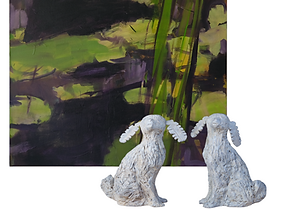
Nick Bodimeade and Christopher Marvell
Plenty - Arundel Gallery Trail Exhibition 2026
For this year's Arundel Gallery Trail and Festival Exhibition we are pleased to show two established artists, one painter of landscapes and the other a figurative sculptor in bronze.
Nick Bodimeade's subject for his new series of paintings is 'Plenty': Excited by last year’s mast or glut crop Nick has been painting fruits, blossoms, verdant growth and abundance. In response to this plenty, and surrounded by his subject matter in his Orchard studio, he fills his canvases with sumptuously handled paint and evocative colour.
Christopher Marvell's sculptures are contemporary classics, reminiscent of ancient or historic pieces. As he puts it, “None of my sculptures are meant to represent anyone or anything in particular. They’re just a head, just an owl, just a dog. They are emblematic: shapes, forms, and emotions.”
Venue TBC
Click this button or image to view
the solo or featured artist page:
From:
22 August 2026
To:
31 August 2026
Private View
TBC